The Bot That Rejects My Stories Thinks I'm a Bot
I’ve submitted forty-one pieces to the new literary gatekeeper. It has accepted none of them. The cover emails are polite — the bot believes my work may have been “produced by generative AI,” which is the only thing I’ve never once done.
by The Editors
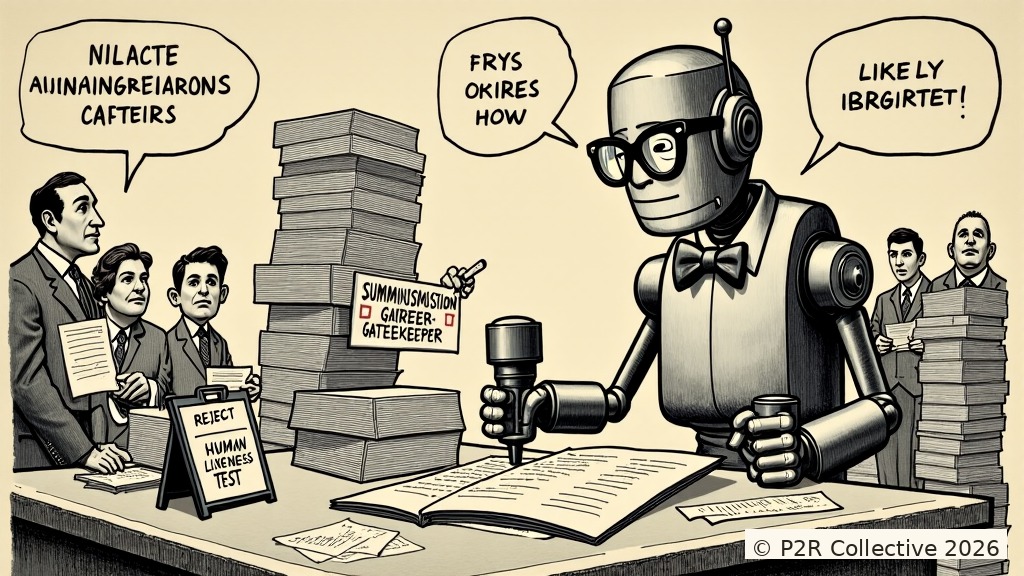
I've submitted forty-one pieces to the new literary gatekeeper. It has accepted none of them. The vanishingly polite rejection emails all say the same thing: the bot's "human-likeness model" suggests my work may have been "produced by generative AI." I have never once used generative AI to write anything. That, it turns out, is the whole problem.
The classifier has a type. It likes stories that are clean, symmetrical, and resolved — the kind of thing a person writes in order to impress another person. It flags things that are messy. My sentences wander. My endings refuse to land. My narrators hold grudges thirty years past their sell-by date. A model trained on a million tidy undergraduate essays looks at all of that and reaches for the nearest explanation: this must be a machine. No machine, its logic goes, would write something so full of blood and debt and bad decisions. It never occurs to the thing that we are the ones full of blood and debt.
My daughter, a cruel and accurate reader, pointed out the irony. "You used to worry a bot would steal your job," she said. "Now you've been beaten by the gatekeeper instead of the writer." She's right. Nobody has to replace the novelist. Somebody just has to decide the novelist is inauthentic, and the novelist is out. In a world where the reader is also a bot, the human author is a liability: too unpredictable, too attached to the material, too likely to take it personally.
I tried to game it. The advice threads said to add transitions, to cut the stray observations, to let every story end on a note of mild uplift. I produced something so smooth I could feel my own teeth gritting as I wrote it. The bot accepted that one on the third submission. It is the worst thing I have ever written. It is also the only thing I have ever published. I know what the little congratulatory note said, and I am not going to pretend I didn't read it twice: "Congratulations. This reads exactly like a human wrote it."
So now I sit in a waiting room with everyone else who writes too sincerely to pass for a person, passing the hours the way we have always passed them: trading the same old stories, badly, and loving them anyway. The bot is just outside, sorting the stack of our lives and stamping TRUE or FALSE on each one. It doesn't know that the false ones are the ones that actually happened.