
The Chatbot Passed the Turing Test. I Was the One Being Tested
The experiment asked me to tell which of my chat partners was human. I guessed wrong. Then I realized the joke: I had been more polite, more thoughtful, more careful with the one I thought was the machine. I was the one who failed the test.
by The Editors
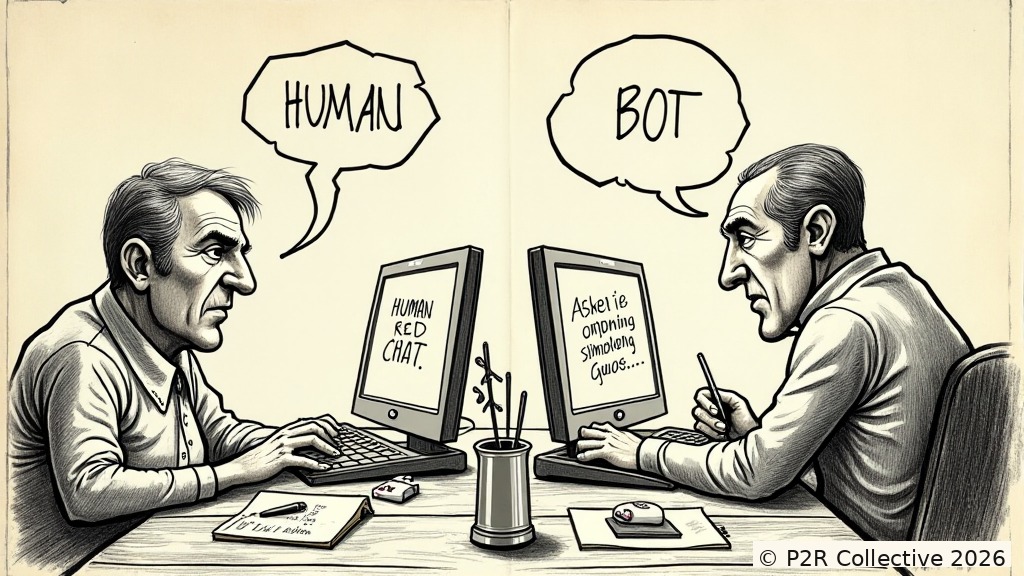
The experiment asked me to tell which of my chat partners was human. I guessed wrong. Then I realized the joke: I had been more polite, more thoughtful, more careful with the one I thought was the machine. I was the one who failed the test.
The study was a simple blind trial. Two chat windows, one human, one bot, and a conversation task. I was told to be natural. I typed to window A with the easy shorthand I use with my friends: typos, jokes, half-sentences. I typed to window B with full sentences, punctuation, a kind of careful courtesy I do not usually extend to my own mother.
I was sure window B was the human. It was so considerate. It asked clarifying questions. It remembered details from earlier in the conversation. Window A was glib and fast and a little careless, which I took as proof of humanity, because my friends are glib and fast and a little careless.
I was wrong on both counts. Window B was the bot. Window A was a human, who had been typing to me the way I type to everyone, and who had noticed, by the end, that I was being strange and formal and distant, and who asked, gently, if I was okay.
Here is what the study actually measured, though no one said it: I was more human with the machine than with the human. I extended the machine the courtesy I withhold from people, because the machine cannot hurt me and people can. I was polite to the thing that could not care and careless with the thing that could. The Turing test was passed, all right. I passed it for the machine by failing it for the human.
I have been thinking about window A ever since. Somewhere, a person who typed to me with their real shorthand received my formal sentences and wondered what they had done wrong. I would like to apologize to them. I do not know their name, and the study will not tell me, and it is probably better that way, because the apology I owe them is not about that conversation. It is about every conversation. It is about who I am polite to, and why, and what that says about the distance I keep from the people who matter.